
Remote mining, construction, energy, and infrastructure projects face a common challenge: how to provide reliable accommodation and essential facilities for workers while keeping construction schedules, logistics, and project costs under control.
In 2026, modular container houses and prefabricated buildings are playing an increasingly important role in solving this challenge.
What was once considered mainly a temporary accommodation solution is becoming part of a broader project infrastructure strategy. Modular buildings can now be used for worker accommodation, site offices, dining facilities, sanitary facilities, management buildings, medical rooms, storage, and other essential functions within a remote project camp.
This shift is particularly relevant to mining companies, EPC contractors, construction companies, infrastructure developers, and project owners operating in locations where traditional construction can be slow, expensive, or difficult to manage.
The key question is no longer simply:
“Should we use container houses?”
Instead, project teams are asking:
“How can modular buildings be integrated into a complete, scalable, and efficient project camp?”
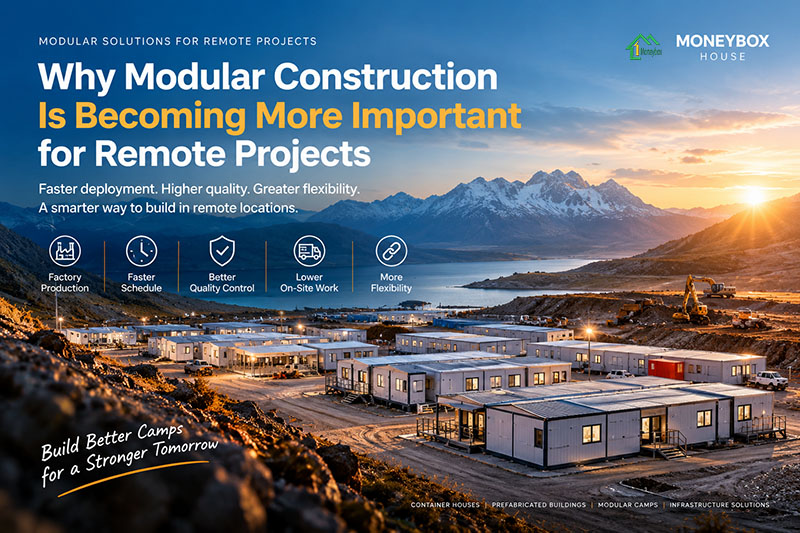
Why Modular Construction Is Becoming More Important for Remote Projects
Remote construction projects have very different requirements from conventional urban developments.
A mining project may be located far from major cities and existing residential areas. A large infrastructure project may need accommodation and offices before permanent facilities are available. A construction project may require hundreds of workers to be housed close to the site for several years.
Under these conditions, traditional construction can create significant challenges.
Materials may need to be transported over long distances. Skilled labor may be difficult to source locally. Weather conditions can affect construction schedules, while site infrastructure such as roads, electricity, water, and drainage may still be under development.
Modular construction provides an alternative approach.
Instead of completing every stage of construction at the project site, major building components can be manufactured under controlled factory conditions and transported to the destination for installation.
This can help reduce the amount of work required on site and make project delivery more predictable.
According to the Modular Building Institute, modular construction can provide significant schedule advantages in suitable applications, while factory production can also improve quality control and reduce disruption at the construction site.
For remote projects, these advantages can be especially valuable.
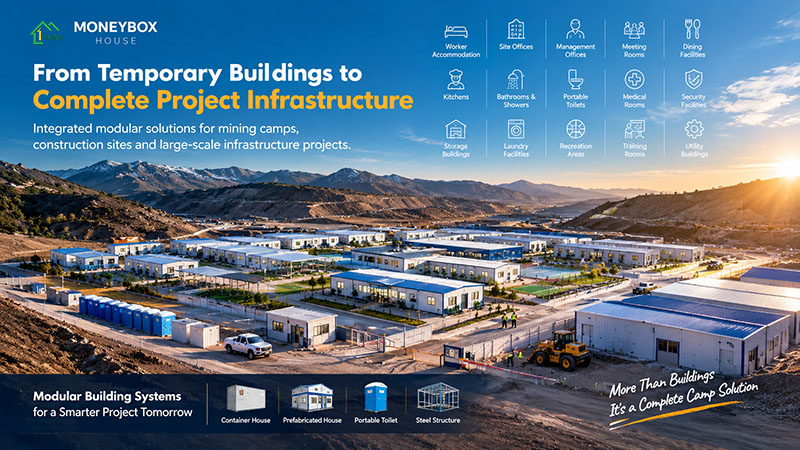
From Temporary Buildings to Complete Project Infrastructure
One of the most important developments in the modular building industry is the transition from individual temporary buildings to complete modular infrastructure solutions.
A large mining or construction camp rarely needs only accommodation.
Depending on the project, a camp may require:
This means that a container house should not always be considered an isolated product.
Instead, different modular building systems can be combined to create an integrated project environment.
For example, a mining camp could use detachable container houses for worker accommodation, prefabricated buildings for offices and dining facilities, portable toilets for sanitary requirements, and steel structures for warehouses or larger-span facilities.
The result is not simply a group of temporary buildings.
It is a modular project camp designed around the operational requirements of the project.
Worker Accommodation Is a Major Application for Modular Buildings
Worker accommodation is one of the most important applications for modular construction in remote projects.
Mining, construction, energy, and infrastructure projects often need to accommodate large workforces before permanent residential facilities are available.
Mining operations provide a clear example.
Many mines are located in remote areas where existing housing infrastructure is limited. Companies therefore need to establish accommodation as part of the wider project development process.
Modular accommodation can provide a practical solution because units can be manufactured away from the project site and transported for assembly at the destination.
Depending on the project requirements, modular accommodation can be configured as:
The system can also be designed around different levels of accommodation, from basic worker dormitories to more comfortable facilities for supervisors, engineers, and project management teams.
The key advantage is flexibility.
Why Scalable Camp Design Matters
Large projects rarely maintain the same workforce throughout their entire lifecycle.
A construction project may start with a relatively small management and preparation team, then require hundreds of workers during peak construction.
A mining operation may also experience changes in workforce size as different stages of development and production begin.
This creates a strong case for phased modular camp development.
Phase 1: Initial Project Team
The first stage may require:
Phase 2: Construction Expansion
As construction activity increases, the project may add:
Phase 3: Full-Scale Operation
Once the project reaches full capacity, the camp may expand further with:
This approach allows the camp to grow with the project rather than requiring the entire facility to be completed at the beginning.
Modular Construction and the Global Labor Challenge
Labor availability is another factor contributing to the growth of modular construction.
Construction projects often require multiple trades working in sequence, including structural workers, electricians, plumbers, interior workers, roof installers, and finishing teams.
In remote locations, finding and managing enough skilled workers can be particularly challenging.
Factory-based construction changes part of this process.
A significant amount of manufacturing and assembly can be completed before the building reaches the project site.
This allows site teams to focus more on:
The result can be a more controlled construction process with less dependence on completing every task in difficult site conditions.
Transportation Should Be Considered Before Choosing a Modular Building
For remote projects, logistics can have a major influence on the overall cost and feasibility of a modular building project.
The building should therefore be designed with transportation in mind from the beginning.
Important considerations include:
Different modular systems provide different logistics advantages.
Detachable container houses can be assembled at the project site and are suitable for projects that require flexible layouts and potential future relocation.
Expandable container houses are designed to provide a compact transportation configuration while creating a larger usable interior space after expansion.
Foldable or Z-Folding Container Houses
Z-folding systems can be useful for projects where transportation efficiency and rapid deployment are important considerations.
Flat pack systems allow building components to be transported in a compact configuration and assembled at the destination, which can be useful for larger quantities of units.
There is no single “best” modular building system for every project.
The right choice depends on project scale, transportation conditions, installation requirements, climate, workforce size, and future plans for the buildings.
One Project May Need Several Building Systems
Large-scale projects often require more than one type of building.
Trying to use the same building system for every function may not always be the most efficient approach.
A better strategy can be to select different systems according to their intended use.
| Project Requirement | Potential Solution |
| Worker accommodation | Container houses / prefab dormitories |
| Site offices | Detachable container houses |
| Rapid deployment | Z-folding container houses |
| Larger living areas | Expandable container houses |
| Dining facilities | Prefabricated buildings |
| Sanitary facilities | Portable toilets |
| Warehouses | Steel structures |
| Training facilities | Prefabricated buildings |
| Medical facilities | Modular buildings |
| Project administration | Container or prefab offices |
This integrated approach changes the way project owners evaluate modular construction.
Modular Buildings Can Support More Flexible Project Lifecycles
Project requirements can change significantly over time.
A construction camp may be needed for several years and then become unnecessary once permanent infrastructure is completed.
A mining project may expand and require additional accommodation.
Another project may need to relocate its workforce facilities to a different area.
This is where modular construction can offer an important advantage.
Depending on the building system and project design, modular buildings may be:
This creates the possibility of treating modular buildings as longer-term assets rather than single-use temporary structures.
For companies managing multiple projects, reusable modular buildings may provide additional value over their lifecycle.
Sustainability Is Becoming Part of the Modular Building Conversation
Sustainability is increasingly influencing decisions about temporary and permanent project infrastructure.
Traditional temporary construction can sometimes involve significant material use by demolition at the end of a project.
Modular construction can provide another approach when buildings are designed for reuse.
A modular building may potentially be moved from one project to another instead of being demolished after the first project ends.
This can support a more circular approach to project infrastructure.
However, sustainability should not be measured simply by whether a building is called “modular.”
The overall environmental performance depends on factors such as:
For project owners, the goal should be to select a modular system that provides practical long-term value while meeting the project's technical and environmental requirements.
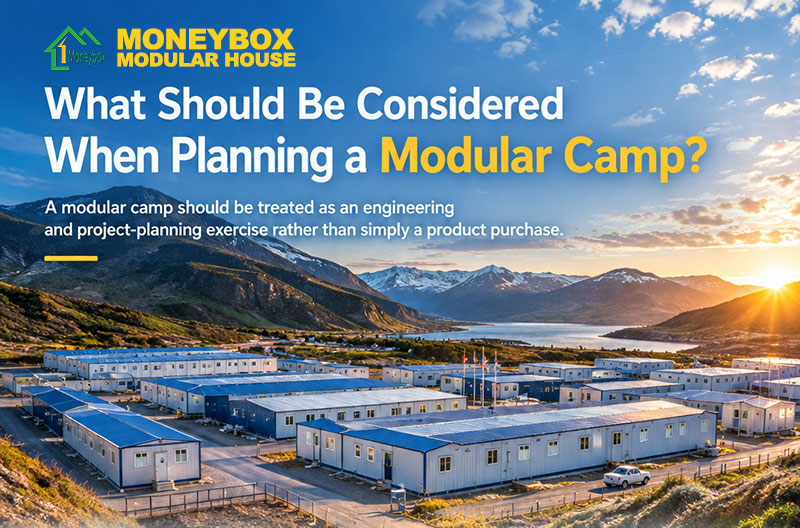
What Should Be Considered When Planning a Modular Camp?
A modular camp should be treated as an engineering and project-planning exercise rather than simply a product purchase.
Before placing an order, project teams should consider several key questions.
1. How Many Workers Need Accommodation?
Determine both the current workforce and expected peak workforce.
For example, a project requiring accommodation for 200 workers today may need capacity for 500 workers during the construction phase.
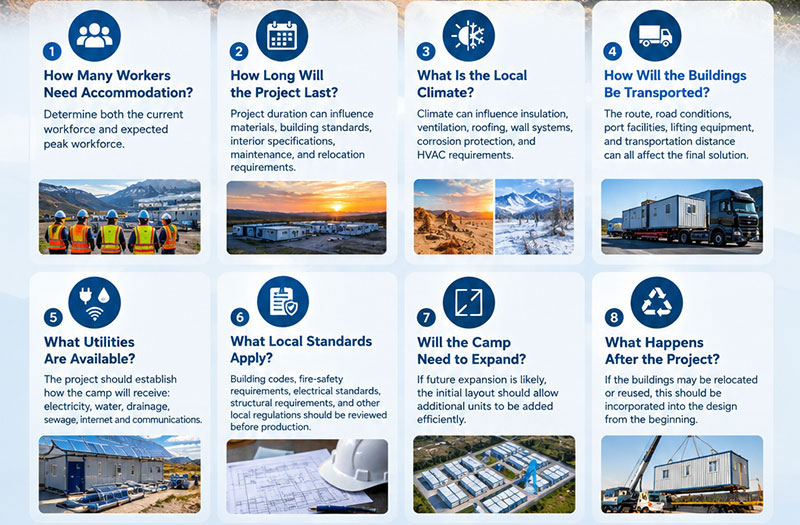
2. How Long Will the Project Last?
A six-month construction project may require a different solution from a ten-year mining operation.
Project duration can influence materials, building standards, interior specifications, maintenance, and relocation requirements.
3. What Is the Local Climate?
Buildings may need to operate in extremely hot, cold, humid, windy, or coastal environments.
Climate can influence insulation, ventilation, roofing, wall systems, corrosion protection, and HVAC requirements.
4. How Will the Buildings Be Transported?
Transportation should be evaluated before finalizing the building design.
The route, road conditions, port facilities, lifting equipment, and transportation distance can all affect the final solution.
5. What Utilities Are Available?
The project should establish how the camp will receive:
6. What Local Standards Apply?
Building codes, fire-safety requirements, electrical standards, structural requirements, and other local regulations should be reviewed before production.
7. Will the Camp Need to Expand?
If future expansion is likely, the initial layout should allow additional units to be added efficiently.
8. What Happens After the Project?
If the buildings may be relocated or reused, this should be incorporated into the design from the beginning.
Modular Container Houses Are Becoming Part of a Bigger Solution
The most important change in the modular building industry is not simply that container houses are becoming more popular.
It is that the role of modular buildings is expanding.
They are increasingly being considered as part of a wider infrastructure system that supports the entire project lifecycle.
For mining companies, this may mean combining worker accommodation with offices, dining facilities, sanitation, medical facilities, warehouses, and recreation areas.
For construction projects, it may mean establishing a complete temporary site environment before permanent facilities are completed.
For infrastructure developers, modular buildings can provide flexible facilities that can adapt as construction phases change.
This makes modular construction particularly relevant to projects where speed, scalability, logistics, and flexibility are critical.
What Is the Future of Remote Project Camps?
The future of remote project accommodation is likely to be increasingly modular, scalable, and project-oriented.
Instead of building large permanent facilities immediately, project owners can increasingly consider infrastructure that develops alongside the project.
A modular camp can start with essential facilities, expand as the workforce grows, and potentially be reconfigured or relocated when project requirements change.
This model is particularly relevant to:
The future is therefore not simply about building faster.
It is about creating infrastructure that can adapt faster.
Conclusion
In 2026, modular container houses and prefabricated buildings are evolving from simple temporary facilities into important components of modern project infrastructure.
For mining camps, construction sites, and large infrastructure projects, the value of modular construction comes from the combination of factory production, faster deployment, scalable capacity, transportation efficiency, standardized quality, and potential reuse.
The most effective solution is not necessarily the cheapest individual building.
It is the building system that best matches the project's workforce, schedule, location, logistics, climate, regulations, and long-term requirements.
For large projects, different modular systems can also work together.
Container houses can provide accommodation and offices. Prefabricated buildings can support larger facilities. Portable toilets can address sanitation requirements. Steel structures can provide warehouses and larger-span spaces.
Together, these systems can create a complete and flexible project environment.
At Moneybox House, we provide container houses, prefabricated buildings, modular accommodation units, portable toilets, and steel structure solutions for construction sites, mining camps, worker accommodation, offices, and large infrastructure projects.
Our approach is project-oriented: understanding the application, workforce, site conditions, transportation requirements, and project objectives before recommending the appropriate modular building solution.
Because the future of remote project infrastructure is not simply about temporary buildings.
It is about building flexible infrastructure that can grow, adapt, and move with the project.
Frequently Asked Questions
What are modular container houses used for?
Modular container houses can be used for worker accommodation, mining camps, construction site offices, dormitories, temporary facilities, project management offices, and other remote project applications.
Are modular buildings suitable for mining camps?
Yes. Modular buildings are widely suited to mining camps because they can be manufactured in factories, transported to remote locations, assembled on site, and configured for accommodation, offices, dining, sanitation, and other camp functions.
Can a modular camp be expanded?
Yes. A modular camp can be planned for phased expansion. Additional accommodation units, offices, dining facilities, sanitary facilities, and other buildings can be added as workforce requirements increase.
What is the difference between a container house and a prefabricated building?
A container house is generally based on a standardized modular structure designed for efficient transportation and assembly. A prefabricated building can use a wider range of structural systems, dimensions, layouts, and materials. The appropriate option depends on the project's requirements.
Can modular buildings be relocated?
Some modular building systems are designed to be dismantled, transported, and reassembled. However, relocation depends on the structural system, foundations, utility connections, transportation conditions, and local regulations.
Why are modular buildings becoming more popular for infrastructure projects?
Modular construction can help address project requirements related to construction speed, labor availability, remote-site logistics, scalability, and flexible facility deployment. It is particularly relevant when accommodation and supporting facilities are needed before permanent infrastructure is available.
What facilities are normally included in a mining camp?
A mining camp may include worker accommodation, offices, dining facilities, kitchens, bathrooms, portable toilets, medical rooms, recreation facilities, storage buildings, security facilities, and other supporting infrastructure.
How do I choose the right modular building system?
The choice should consider workforce size, project duration, transportation conditions, climate, local regulations, installation requirements, utility availability, budget, and whether the buildings may need to be expanded or relocated in the future.


 Servicio en línea
 +86-020-34800775+8618818900230
 export@moneyboxhouse.com
 +8615920397177
 1198017314
 español
  English
 français
 Deutsch
 русский
 italiano
 português
 Nederlands
 Ελληνικά
 हिन्दी