

Shutterstock
1. Introduction: Why the G20 Summit Matters to the Construction Industry
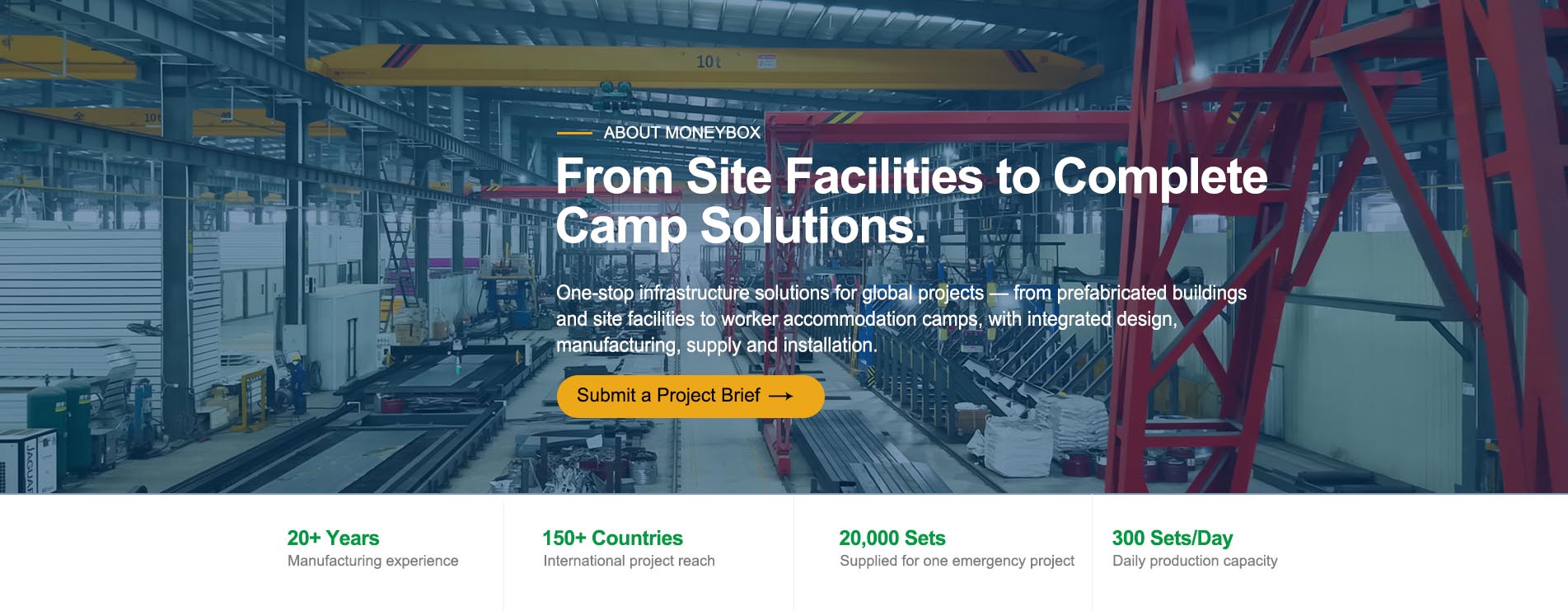
The G20 Leaders' Summit is one of the world's most influential international economic and political gatherings. Bringing together major economies, the summit provides a platform for discussing global economic growth, international trade, energy security, technological innovation and economic cooperation.
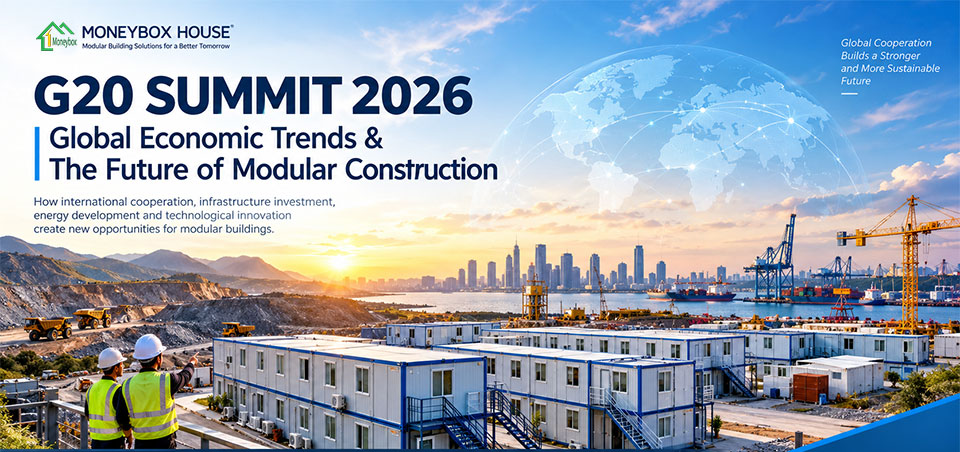
The 2026 G20 Leaders' Summit will take place on December 14–15 in Miami, Florida, under the United States presidency.
This year's US G20 presidency has established three core priorities: promoting economic prosperity by reducing regulatory burdens, securing affordable and reliable energy supply chains, and advancing innovation in artificial intelligence and emerging technologies.
Economic growth requires infrastructure. Energy development requires industrial facilities. Mining expansion requires workforce accommodation. New technology industries require offices, operational facilities and supporting infrastructure.
These developments create opportunities for construction solutions that can be manufactured efficiently, transported internationally and installed within relatively short project schedules.
2. Global Infrastructure Investment: Creating New Demand for Modular Buildings
Infrastructure development remains an important foundation of global economic growth.
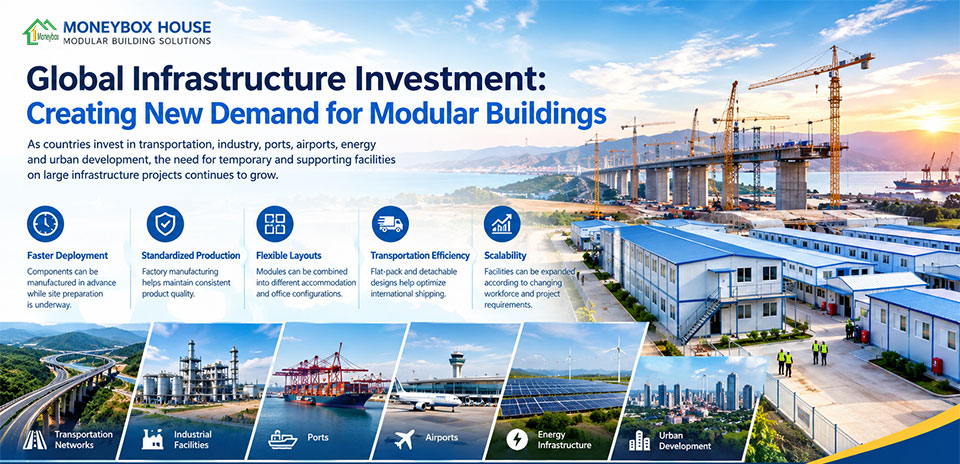
Countries investing in transportation networks, industrial facilities, ports, airports, energy infrastructure and urban development require not only permanent buildings but also extensive temporary and supporting facilities during construction.
Large infrastructure projects often involve hundreds or thousands of workers operating in locations far from established urban centers.
Providing accommodation, offices, dining facilities, sanitary facilities and management spaces becomes an important part of project planning.
This is where modular construction offers practical advantages.
Compared with conventional on-site construction, factory-manufactured modular buildings can provide several benefits:
- Faster Deployment: Building components can be manufactured in advance while site preparation takes place.
- Standardized Production: Factory manufacturing helps maintain consistent product quality.
- Flexible Layouts: Individual modules can be combined into different accommodation and office configurations.
- Transportation Efficiency: Flat-pack and detachable designs can help optimize international shipping.
- Scalability: Facilities can be expanded according to changing workforce and project requirements.
For infrastructure contractors, these advantages can help improve construction-site organization and reduce the time required to establish supporting facilities.
As international infrastructure investment continues, demand for prefabricated offices, worker accommodation and modular site facilities may also increase.
3. Energy Security and Industrial Development: New Opportunities for Modular Construction
Energy security is one of the major priorities of the 2026 US G20 presidency.
Reliable and affordable energy supplies are essential for industrial production, transportation, manufacturing and economic development.
Across different regions, investments in oil and gas, electricity generation, power transmission, nuclear energy and renewable energy continue to create demand for supporting infrastructure.
However, energy projects require much more than power generation equipment and technical installations.
They also need construction teams, engineering personnel, maintenance workers and operational management facilities.
For remote energy projects, establishing accommodation and administrative facilities can be particularly challenging.
Modular buildings can serve several important functions:
Worker Accommodation
Prefabricated dormitories and container houses provide practical living spaces for engineers, technicians and construction workers.
Site Offices
Modular office buildings can accommodate project management teams, engineering departments and administrative personnel.
Operational Facilities
Custom-designed modular buildings can be used for control rooms, maintenance offices, equipment support facilities and other project-related applications, subject to the required technical specifications.
Canteens and Welfare Facilities
Modular layouts can integrate dining areas, sanitary facilities and common spaces to support large workforces.
As energy investment expands, modular construction suppliers may find opportunities in both new energy developments and conventional energy infrastructure.
4. Mining Development and Remote Workforce Accommodation
The connection between international economic policy and modular construction is particularly clear in the mining industry.
Countries with significant mineral resources continue to attract investment in mining exploration, extraction, processing facilities and transportation infrastructure.
However, many mining projects are located in remote regions where existing housing, roads, utilities and public facilities are limited.
Developing a mining operation therefore requires a comprehensive supporting infrastructure system.
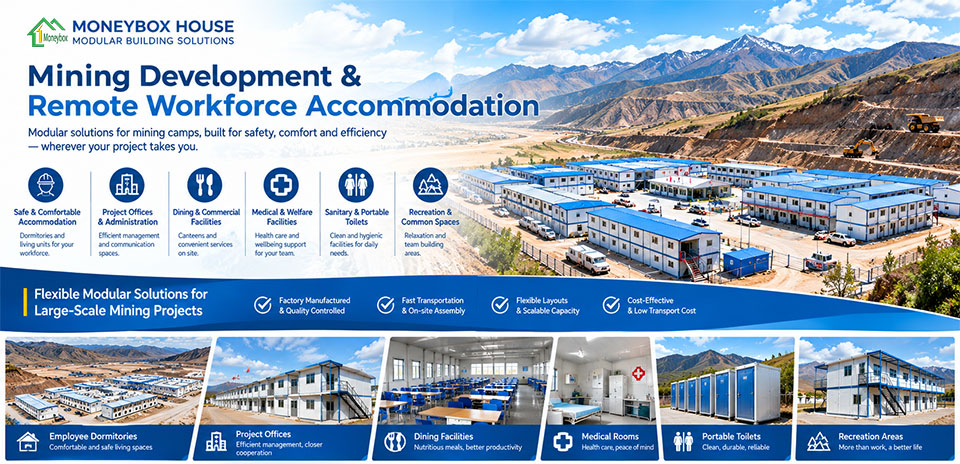
A mining camp may include:
- Employee dormitories and accommodation units.
- Project management offices and administrative buildings.
- Dining halls and commercial facilities.
- Medical rooms and welfare facilities.
- Sanitary facilities and portable toilets.
- Recreation areas and common spaces.
For projects involving hundreds or thousands of workers, the construction schedule and transportation arrangements become particularly important.
Modular mining camps provide a flexible approach to establishing these facilities.
For example, detachable container houses and prefabricated K-type or T-type buildings can be arranged into large accommodation complexes according to workforce requirements and available site conditions.
Expandable container houses can also provide more spacious accommodation options for specific residential and hospitality applications.
The ability to manufacture multiple building units in a factory, transport them to remote locations and assemble them on site makes modular solutions worth considering for large-scale mining developments.
5. Artificial Intelligence and Emerging Technologies: The New Demand for Industrial Facilities
Another important priority of the 2026 G20 presidency is technological innovation, particularly artificial intelligence and emerging technologies.
The rapid development of AI is driving investment in data centers, semiconductor manufacturing, advanced industrial facilities and digital infrastructure.
These industries require specialized buildings with strict requirements for electrical systems, cooling, fire protection, structural performance and operational reliability.
Not every modular building is suitable for these applications. Data centers and other critical facilities require highly specialized engineering design.
Nevertheless, their development creates demand for supporting facilities, including:
- Construction-site management offices.
- Engineering and technical staff accommodation.
- Temporary administrative buildings.
- Equipment storage and maintenance facilities.
- Security and site management buildings.
This creates another potential application for prefabricated construction.
As technology-related investment expands, modular buildings can help provide supporting facilities for construction and industrial operations, even when the primary industrial infrastructure requires conventional or specialized construction methods.
6. International Trade and Supply Chain Efficiency: Why Factory Manufacturing Matters
International trade and supply chain security are also important subjects within the 2026 G20 process.
Construction projects frequently involve international procurement. Steel, sandwich panels, electrical components, doors, windows and other building materials may come from different countries and suppliers.
This makes procurement coordination, manufacturing consistency, transportation costs and delivery schedules important considerations.
Factory-based modular construction offers an approach to organizing these processes more systematically.
For international buyers, the advantages include:
Centralized Manufacturing
Building components can be produced under controlled factory conditions, with standardized production procedures.
Integrated Procurement
Structural steel, sandwich panels, flooring, doors, windows and electrical components can be coordinated within one manufacturing process.
Optimized Shipping
Different modular building designs offer different transportation advantages. Flat-pack and detachable container houses can help improve loading efficiency compared with transporting fully assembled buildings.
International Project Coordination
Manufacturers with experience in overseas projects can support product customization, production planning, export packaging, delivery coordination and installation guidance.
For buyers managing projects across multiple countries, these factors can influence the overall cost and efficiency of building procurement.
7. What Do These Global Trends Mean for the Future of Modular Construction?
Several long-term trends are particularly relevant to the modular construction industry.
First, infrastructure development will continue to require supporting facilities.
Large transportation, energy and industrial projects need accommodation, offices and other facilities throughout their construction and operational phases.
Second, remote project development will increase the importance of transportation and installation efficiency.
Mining, energy and infrastructure projects in geographically challenging locations require building solutions that can be transported and deployed efficiently.
Third, international procurement will place greater emphasis on manufacturing capabilities.
Buyers are increasingly interested in suppliers that can provide coordinated manufacturing, customization, quality control and international delivery support.
Fourth, flexible building systems will become increasingly relevant.
Project requirements can change as workforce numbers, construction schedules and operational needs evolve. Modular buildings offer different layout and expansion possibilities.
These trends suggest that modular construction should be viewed not simply as an alternative building method, but as part of the wider infrastructure supply chain.
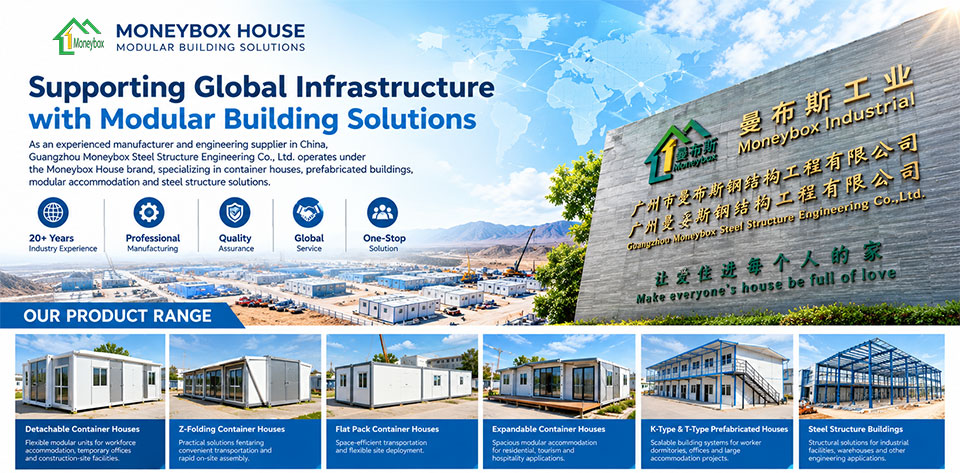
8. Moneybox House: Supporting Global Infrastructure with Modular Building Solutions
As an experienced manufacturer and engineering supplier in China, Guangzhou Moneybox Steel Structure Engineering Co., Ltd. operates under the Moneybox House brand, specializing in container houses, prefabricated buildings, modular accommodation and steel structure solutions.
Our product range includes:
- Detachable Container Houses: Flexible modular units for workforce accommodation, temporary offices and construction-site facilities.
- Z-Folding Container Houses: Practical solutions featuring convenient transportation and rapid on-site assembly.
- Flat Pack Container Houses: Space-efficient transportation and flexible site deployment.
- Expandable Container Houses: Spacious modular accommodation for residential, tourism and hospitality applications.
- K-Type and T-Type Prefabricated Houses: Scalable building systems for worker dormitories, offices and large accommodation projects.
- Steel Structure Buildings: Structural solutions for industrial facilities, warehouses and other engineering applications.
Different projects require different building configurations. Our approach focuses on understanding project requirements, selecting appropriate structural and building systems, and coordinating manufacturing and delivery.
For large infrastructure developments, modular buildings can be integrated into broader project planning to provide employee accommodation, administrative offices, dining facilities and supporting site infrastructure.
Moneybox House has over 20 years of experience serving international clients, aiming to provide support to contractors, developers, engineering companies, and project investors seeking practical modular building solutions.
9. Conclusion: Connecting Global Economic Development with Modular Building Opportunities
The 2026 G20 Summit highlights several important directions for the global economy: economic growth, energy security, international supply chains and technological innovation.
Although these discussions take place at the level of governments and international organizations, their implications extend into many industries, including construction, engineering, manufacturing and infrastructure development.
As countries invest in energy facilities, mining operations, transportation networks and industrial development, the need for supporting buildings and workforce accommodation remains an important consideration.
Modular construction offers a flexible approach to meeting some of these requirements through factory manufacturing, standardized production, efficient transportation and adaptable building layouts.
At Moneybox House, we believe that modular buildings are not just individual products. They are an important part of the supporting infrastructure that helps large projects move from planning to construction and operation.
Frequently Asked Questions (FAQ)
Q1: What is the G20 Summit 2026?
The G20 Leaders' Summit 2026 is an international meeting of leaders from the world's major economies. It will take place in Miami, Florida, on December 14–15, 2026, under the United States presidency.
Q2: How does the G20 Summit relate to the modular construction industry?
The G20 discusses global economic growth, energy security, international trade and technological innovation. These areas influence investment in infrastructure, industrial facilities and energy projects, which can create demand for modular buildings and prefabricated accommodation.
Q3: Why are modular buildings suitable for mining and infrastructure projects?
Modular buildings can be manufactured in factories, transported to project locations and assembled on site. They offer flexible layouts and can provide accommodation, offices, dining facilities and other supporting buildings for remote projects.
Q4: Can container houses be used for large-scale mining camps?
Yes. Depending on structural design, local building regulations, utilities and project requirements, container houses can be combined into accommodation complexes for large workforces. They can also be integrated with offices, canteens and other supporting facilities.
Q5: What should international buyers consider when purchasing modular buildings?
Important considerations include structural design, local building codes, wind and snow loads, fire performance, thermal insulation, transportation costs, installation requirements, manufacturing quality and after-sales support.
Q6: What is the difference between modular construction and traditional construction?
Traditional construction is generally carried out mainly on site, while modular construction involves manufacturing building units or components in factories before transporting and assembling them at the project location. The two approaches can also be combined within one project.
---


 Servicio en línea
 +86-020-34800775+8618818900230
 export@moneyboxhouse.com
 +8615920397177
 1198017314
 español
 English
 français
 Deutsch
 русский
 italiano
 português
 Nederlands
 Ελληνικά
 हिन्दी